
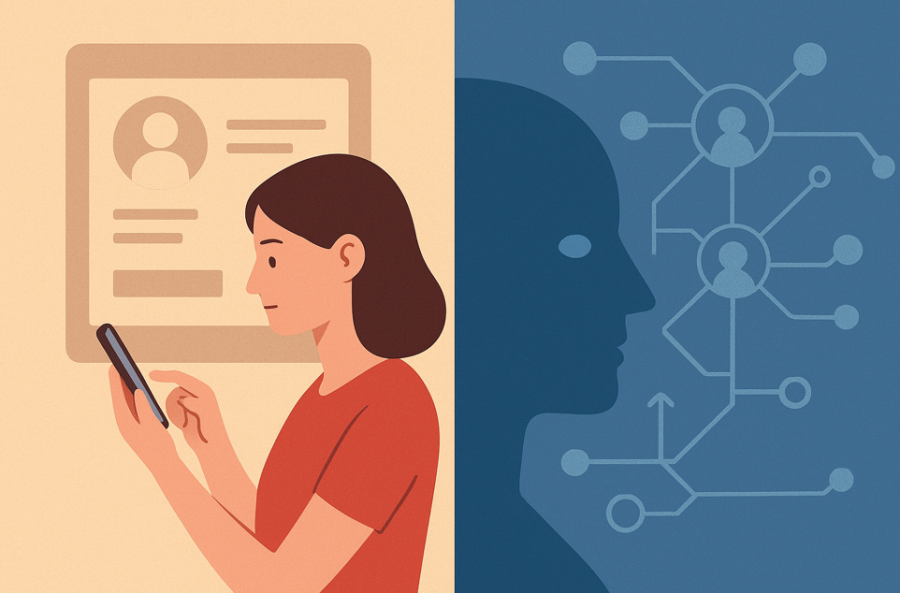
Today, as digital media permeates our daily lives, the way we construct “who I am” is undergoing a fundamental transformation quietly. In the past, our identities were often rooted in relatively stable soil – family, career or those long-term social roles we played. Nowadays, with the popularization of digital media, identity seems to have entered a “programmable” state: we constantly produce, update and present narratives about ourselves through images, text and data streams.
The sociologist Goffman (1959) once compared interpersonal interaction to a “performance”, arguing that we would step onto different “stages” in various social situations and play appropriate roles to shape specific impressions in others’ minds. The digital age has undoubtedly magnified this “performance logic”. Nowadays, on platforms like Weibo, Instagram, and Xiaohong Shu, we carefully select avatars, retouch pictures, and deliberate on copywriting to present the “self” that we hope to be seen. Social media has undoubtedly become the most important public stage in modern life, and each of us is both an actor on the stage and an audience member of one another. In the flow of different communities and algorithms, we continuously weave our own “digital avatars”.
However, digital identities are not entirely written by us independently. As scholar Van Dick(2013) put it, the structure of algorithms and platforms is deeply involved. By tracking our data, analyzing our behavior, and pushing content we might like, the platform not only reflects our interests but also imperceptibly influences how we view ourselves and others. Thus, digital identity has become the product of the entanglement between “self-expression” and “being shaped by algorithms”.
In such an environment profoundly influenced by technology, we need to cultivate a clearer ability to reflect on media and to be more aware of identity management so as not to lose ourselves in the digital torrent. Digital identity is not merely a mirror reflecting oneself; it is also a scene where social power, technological logic and personal will are constantly at play. It constantly reminds us that while we strive to be seen, we are also redefining the way we are seen.
Reference list:
1.Goffman, E. (1959). The presentation of self in everyday life. [online] psycnet.apa.org. Available at: https://psycnet.apa.org/record/1959-15044-000.
2.van Dijck, J. (2013). The Culture of Connectivity: A Critical History of Social Media. [online] academic.oup.com. Oxford University Press. Available at: https://academic.oup.com/book/9914.


I liked how you described social media as the ‘stage of modern society’ where users act as both actors and audience members, constantly shaping their ‘digital selves’ to meet community expectations. Additionally, your reference to van Dijck’s point that ‘platforms not only showcase users’ interests but also subtly reshape their self-perception and social relationships’ really highlights the complexity between technology and identity in the digital age
I think this is a really strong post, especially the way you tie Goffman’s performance theory into digital identity without over explaining it. It’s very clean and academic but still understandable. I also like that you bring in van Dijck because most people forget the algorithmic side completely, so it’s good that you’re not treating digital identity as something we freely control. When you talk about algorithms reshaping self-perception, maybe further explain how that happens. Like how recommendation feeds push people toward certain aesthetics or communities, which then ends up influencing how they present themselves. You already imply it, but making it clearer would strengthen your point.