
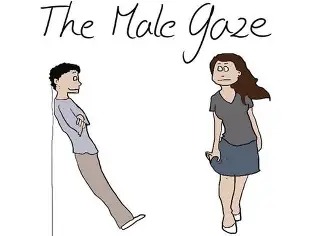
Since Laura Mulvey proposed the concept of the male gaze in 1975, it has been widely used to analyze how images present women as objects of heterosexual male desire both narratively and visually. Although the film and television industry has experienced diversification over the past decades, the tradition of the male gaze still deeply shapes contemporary image production.

Image from Laura Mulvey Fot Mariusz Kubik July 24 2010 06 – Laura Mulvey – Wikipedia
Predicament
Nonetheless, in the actual film and television production process, from casting to scriptwriting to visual language, the male gaze consistently holds a significant structural influence. Hollywood has long been saturated with stereotypical roles tailored to depict the image of women.

Image from http://baike.sogou.com/v920528.htm

Image from https://www.zhihu.com/topic/20222451/intro
For example, a group of actresses from the 1990s, led by Jennifer Aniston and Meg Ryan. They were often referred to as America’s sweethearts, frequently playing similar roles that largely highlighted their charming appearances.
This is not coincidental, but stems from a long-standing narrative authority in the industry predominantly held by male workers. Mulvey (1975) emphasized that mainstream cinema often aligns the camera’s perspective with that of a male audience, thereby rendering women as the ‘visual spectacle’ rather than as narrative subjects with genuine agency.

This gaze is also reflected in the technical presentation. The meaningless emphasis on fragmented shots of women’s bodies and the stylizations designed to please the audience, among others. Film scholar Ann Kaplan (1983) pointed out that these visual strategies essentially construct a ‘scopophilic relationship,’ where female characters are positioned to please the viewer’s gaze rather than to showcase their full character depth.
Change


Image from https://www.douban.com/doubanapp/dispatch?uri=/photo/1715884264/&dt_dapp=1
However, the film and television industry is undergoing changes. With female directors and more diverse writing teams entering the mainstream production system, an increasing number of works are beginning to challenge this system. Female characters are also becoming the foundation of a new industry discourse. A typical example is the 007 series, which, as the world’s most successful spy film franchise, featured so-called Bond Girls in its early films who were seriously objectified. They spent most of their time as vases waiting to be rescued by the male protagonist. Nowadays, the female characters in the series are receiving significantly more attention. Eastern, strong female characters, exemplified by Michelle Yeoh, also play a major role in advancing the plot. Hooks (1992) emphasized that marginalized audiences can resist and rewrite these visual structures through critical viewing of mainstream media, and this ‘resistant gaze’ is increasingly becoming a cultural force.
Recent Developments


However, over the past two years, Hollywood has experienced a phenomenon of counterproductive extremes. Many film companies appear to exploit female-centric themes and minority representation merely as a pretext for profit, without making real progress in artistic expression or content depth. Notably, a series of commercially produced Marvel films and television shows, such as Madame Web and Ironheart, have been particularly affected. These works are rife with illogical plot developments and stereotypical portrayals of women and minority groups, clearly driven by financial motives.
It is comforting to know that we can still see more excellent works. Just like Prima Facie and The Substance, they both allow us to see the inequality and social pressure that women in the workplace face today.

In recent years, audiences have become increasingly receptive to visual representations that diverge from traditional male narrative frameworks. However, the market-driven nature of visual modes means that discussions on the male gaze still hold practical significance today.
Reference
hooks, b. (1992) Black Looks: Race and Representation. Boston: South End Press.
Kaplan, E. A. (1983) Women and Film: Both Sides of the Camera. New York: Routledge.
Mulvey, L. (1975) Visual Pleasure and Narrative Cinema. Screen, 16(3), pp. 6–18.


You really did a good job. The blog focus on how these ideas can be applied to understand contemporary examples of films and your title is clearly showing your theme of the blog. I agree your view that many women were seriously objectified in many early movies such as 007 series. Fortunately, more movies show female power now and more people accept it. The male gaze has pros and cons, so we need to balance the scale.
I really enjoyed reading your blog on the male gaze in the film industry, and the examples you chose really helped me think more deeply and relate Mulvey’s theory to reality. As Mulvey argues, classical cinema often frames the camera and the audience through a male perspective, so that female characters are positioned mainly as objects of visual pleasure rather than as fully developed subjects.
And your discussion of the 007 films shows this very clearly: the “Bond girls” are mostly there to be looked at and to support the male hero, rather than to drive the storyline themselves. Even though we don’t want this phenomenon to keep spreading in the future, it is still visible in many films today. At the same time, I believe there will be more and more movies that highlight female power, challenge gender stereotypes, and go beyond presenting women only through their visual beauty.