

Why do so many films show women the same way? It’s always the one-dimensional, sexy, damsel-like character that has no development except to push the man to make the correct decision at the climax of the film. This is due to a concept introduced by Laura Mulvey, known as the Male Gaze. Through her book Visual and Other Pleasures, Mulvey introduced the idea that cinema is structured for heterosexual male pleasure and called it the Male Gaze. She suggested that cinema has made female characters into objects to be looked at, rather than characters with thoughts, feelings, or autonomy. This blog will delve deeper into this concept, examining its origins and its continued relevance in today’s society.

Superhero films are a perfect example of this. Natasha Romanoff’s first appearance in the Marvel universe is in Iron Man 2. The most noticeable thing about her introduction is the way the pan camera slowly pans down her figure multiple times, as well as body-centred camera movements, and scenes that emphasise her physical appearance over her skills as a spy. This reflects Mulvey’s idea of “to-be-looked-at-ness”, where women are often made to be seen as objects of male spectatorship and approval. Natasha’s role early on in the film was to serve as eye candy for Tony Stark, even though she is an elite spy. This reinforces Mulvey’s argument that female characters are often passive and sexualised in film, whilst men are actively engaged and pushing the story forward. The promotional posters for The Avengers also align with this theory. In line with Goffman’s analysis of gender display, Black Widow is turned away from the camera, her hips out, and looks back in a tight catsuit. This is a stark difference from the way the male heroes are faced forward in action stances, ready to fight.
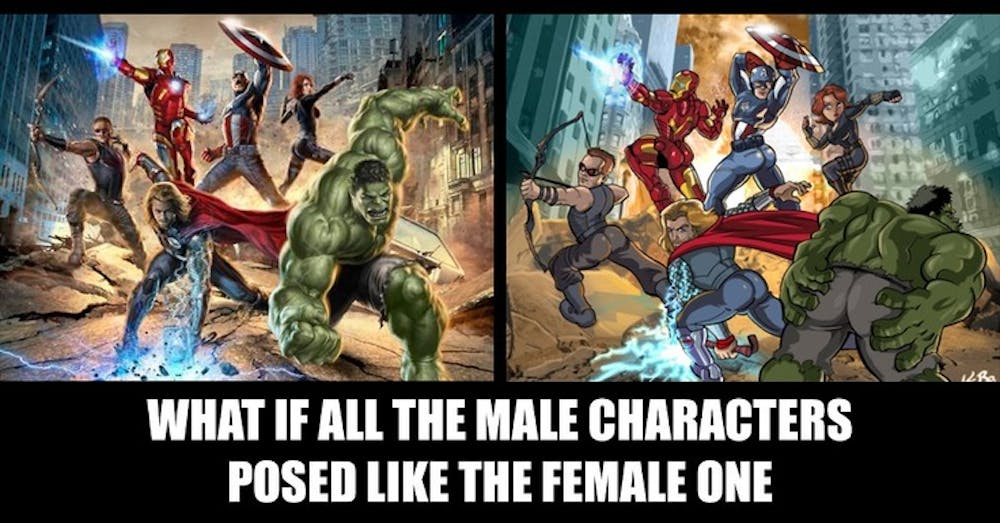
Because Laura Mulvey was writing about Hollywood in the 1970s, there are some limitations within the theory in terms of the media we see online today. She never fully explains how women, queer viewers or even influencers themselves experience the gaze, so it’s not a well-rounded argument. Bell Hooks argues that viewers, especially people of colour, establish oppositional ways of seeing that purposefully resist Hollywood images. This challenges Mulvey’s original assumption of a single, universal viewer, as these individuals critique the work rather than simply being passive viewers.

In conclusion, the concept of the Male Gaze remains a valuable framework for understanding how women are portrayed from film to social media algorithms and advertising. The example of Black Widow illustrates how even the most well-known films have employed cinematic techniques to objectify women visually. However, theories like the Oppositional Gaze show us that representation is changing rapidly, and by recognising these patterns, we can become more aware of the media we consume and encourage more conscious viewing.
References:
- Internet Archive. (2022). Visual and other pleasures : Mulvey, Laura : Free Download, Borrow, and Streaming : Internet Archive. [online] Available at: https://archive.org/details/visualotherpleas0000mulv? [Accessed 26 Nov. 2025]
- Loreck, J. (2018). Explainer : what does the ‘ male gaze ’ mean , and what about a female gaze ? [online] Available at: https://www.semanticscholar.org/paper/Explainer-%3A-what-does-the-%E2%80%98-male-gaze-%E2%80%99-mean-%2C-and-Loreck/9797811ede23bd5f835692aa4970d1cacf3661b0? [Accessed 1 Dec. 2025].
- Goffman, E. (1979). Goffman Gender. [online] Available at: http://www.publiccollectors.org/Goffman_Gender.pdf.
- Hooks, B. (1992). BLACK LOOKS: Race and Representation. [online] Available at: https://aboutabicycle.wordpress.com/wp-content/uploads/2012/05/bell-hooks-black-looks-race-and-representation.pdf.
- Gill, R. (2023). Gender and the Media. HETEROCYCLES, [online] 92(1). doi:https://doi.org/10.3987/contents-16-9201.


This is such an important point to raise, especially in the context of modern media. The Male Gaze has been so ingrained in cinema and pop culture that it is so easy to overlook how often female characters are reduced to objects of desire, instead of fully developed individuals with their own story arcs. The example of Natasha Romanoff in Iron Man 2 really shows how even strong female characters can be introduced in a way that emphasises their physicality over their skills. This objectification directly impacts how women are viewed in society, and how we view ourselves as women, too. Love how you introduced the concept of the Oppositional Gaze; looking at it from the other side, it almost makes it seem ridiculous. Hopefully, we will see more characters and stories that break away from these limiting stereotypes.
This piece was well done. Your analysis provides a clear and relevant application of Mulvey’s concept of the male gaze, and you effectively connect it to Natasha Romanoff’s introduction and early portrayal. The use of pictures really paints a good picture of what you are trying to illustrate. Raises an essential critique of Mulvey by foregrounding the limits of her original framework, especially in relation to contemporary media environments. Your use of bell hooks is especially effective, as it highlights how positionality shapes the spectator’s experience. Underscoring that viewers bring their own histories, identities and forms of resistance helps illustrate why Mulvey’s assumption of a homogenous spectator no longer holds. I really enjoyed this
This blog post clearly demonstrates the need for critical analysis of theory in the media today. Your examples were well thought about and were relevant to ‘the male gaze’ theory. In the media today, as an industry it has taken steps to ensure that more female representation in movies, radio and TV are a lot more equal and main characters are not always male. The media have also moved into a positive direction to a more positive and fair representation of women rather than a stereotypical representation. Your point on how Mulvey could expand her research and theory more to include diverse and alternative views and opinions is a very valid point as a counteractive argument to this theory.
This post was written in a very good way. Opening with a question about how women are portrayed in shows/films gets the readers thinking which is clever. It made me think about recent shows and films i’ve watched and has made me question how much f the male gaze we miss in our day to day lives. It still happens constantly on social media, on the big screens and in real life, yet are we too used to it to notice subtle hints of it still? Very well done.
This article is written in a very smooth and clear way, and it does a great job explaining Mulvey’s idea of the “male gaze” while also giving concrete and convincing examples from modern films. The author starts with a simple but powerful question—“Why are women in films always shown in the same way?”—and this opening not only grabs the reader’s attention but also directly points to the core problem of how the male gaze shapes both storytelling and visual style. The explanation of Mulvey’s theory is brief but effective, helping readers quickly understand the main idea: that cinema often builds images for the pleasure of heterosexual men.
In the example section, the choice to analyze Natasha Romanoff (Black Widow) in Iron Man 2 and the promotional posters of The Avengers is very fitting. The discussion of “to-be-looked-at-ness” is accurate and clearly shows how camera movement, framing, and narrative power work together to create a sexualized female image. Bringing in Goffman’s gender display theory is another strong point—it shows that the author understands not only film theory but can also connect it with sociological ideas to make the argument stronger.