
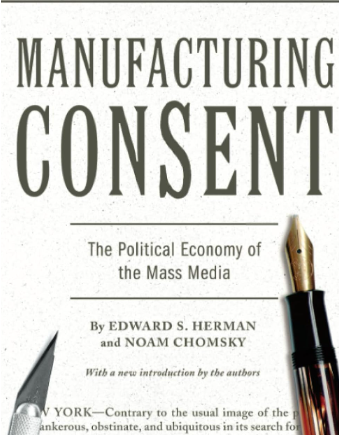
When we browse the news, social media, and listen to podcasts every day, most of the information we see and the viewpoints we form are actually being “filtered” and “organised” by the media system. This is exactly the question that Manufacturing Consent wants us to re-examine: Are public opinions formed independently, or are they “manufactured” within the structure?
- What is “Manufacturing Consent” ?
Manufacturing literally means “producing agreement”. Refers to how mass media and elites shape public opinion so citizens “agree” with official agendas. Questions whether democracy truly reflects independent public judgment.
This phrase was first mentioned by Walter Lippmann in the 1920s, and later Chomsky and Herman redefined it in the1980s.
2. Lippmann : A world where the masses need to be “guided”.
Walter Lippmann was an American writer, reporter, and political commentator. He proposed “Manufacturing Consent” in 1922. His view is that the world is too complex for the general public to directly understand reality. The mass media must simplify complex events into understandable images. Experts and elites need to organise public opinion. “Manufacturing Consent” is a necessary technique in a democratic society.
3. Chomsky: The media is not neutral but an elite propaganda system.
Chomsky and Herman redefined “Manufacturing Consents” in 1988. They believe the media serves the interests of the government, large enterprises, and power structures. There are “five filters” that determine what can be reported. The news framework leans towards the official narrative. The “consent” of the public is structured, not freely formed.
4. Differences Between the Two
Lippmann and Chomsky both agreed that the media plays a powerful role in shaping consent — but they saw it differently. Lippmann focused on the need for experts, while Chomsky and Herman warned against how those experts might serve power instead of truth.
5. Applications in the present era
First, the algorithms are a new “filter”. Social platforms push content based on commercial interests, trapping the public in information cocoons. Second, the news framework influences viewpoints. Different media choose different perspectives, influencing how the public views the core issues of the events. Third, the topic decides what people focus on. Both the reported content and the overlooked issues are shaping the direction of public discussion. Fourth, media literacy has become a crucial skill. Understanding the filtering mechanism is the first step to forming an independent judgment.
In conclusion, both Walter Lippmann and Chomsky force us to think critically about the media’s role in democracy. Lippmann tells us that public opinion must be managed because the world is too complex, and Chomsky warns us that this management can easily become manipulation.
So, what “Manufacturing Consent” actually means today is less about governments controlling us, but more about a system that pushes us toward certain ideas and makes us believe we choose them by ourselves through media, advertising, and algorithms.


This is a thoughtful, well-structured explanation. You take a big, heavy idea and make it feel real for how we use media today. I appreciate how you illustrate the shift from Lippmann’s assertion that people need help making sense of the world to Chomsky’s warning that the people “helping” might actually be steering us. The way you connect algorithms to today’s hidden filters really hits — it makes it clear how much of what we see online is not random, but carefully shaped by commercial interests and engagement tricks, quietly steering what we pay attention to and how we think about it. Overall, it is a good reminder that our opinions do not appear out of nowhere — the system around us shapes what we see, what we think about, and what feels “normal”.
I actually really like how structured this is. It’s super easy to follow, and breaking it into sections helps a lot since this topic can get confusing fast. You explain Lippmann vs Chomsky in a way that’s simple but still accurate, which is honestly hard to do, so that’s already great. I think your conclusion is really good, but you could make the shift to the present day even clearer by tying it back to your intro question (as in “are our opinions actually ours?”). You touch on it, just needs a tiny bit more emphasis so the whole thing loops together smoothly.
I think this is a really well-written post, harbouring on the question ‘why is it still important today’. I think with how fast the online world moves, it’s important to remember these things. Especially when knowing the algorithm is almost completely out of our control, and is curated specially for each individual. It’s a good read with an important message, and the title is what drew me in in an instant. Well done!