
Everytime I open my social media app like Tiktok/Xiaohongshu, my feed fills with the same kinds of videos: outfits check, dance, “body reveals”. The camera often starts at the legs and slowly moves upwards. At first, I’m just curious to see how the outfits look on a real person , but that curiosity gradually turns into discomfort as I start to wonder: who is the potential audience for this? Why do so many videos feel like they are shot for a heterosexual male viewer – even when the creator is a woman? This raises a core question: How does the male gaze infiltrate our daily social media experience?

Drawing on Laura Mulvey’s idea of the male gaze(Mulvey, 1975), mainstream cinema often assumes a heterosexual male spectator: women are framed as visual spectacle, while men occupy the active, looking position. Yet, as bell hooks argues with her notion of the oppositional gaze (hooks, 1992), not all women are addressed or represented in the same way. Black women, for example, have historically watched the screen with a critical, resistant gaze, refusing easy identification with white heroines or sexist, racist storylines. If cinema has trained us to see through a gendered and racialised male gaze, what happens when we are the ones holding the camera on TikTok or Xiaohongshu?
Screenshot from Xiaohongshu(RedNote)
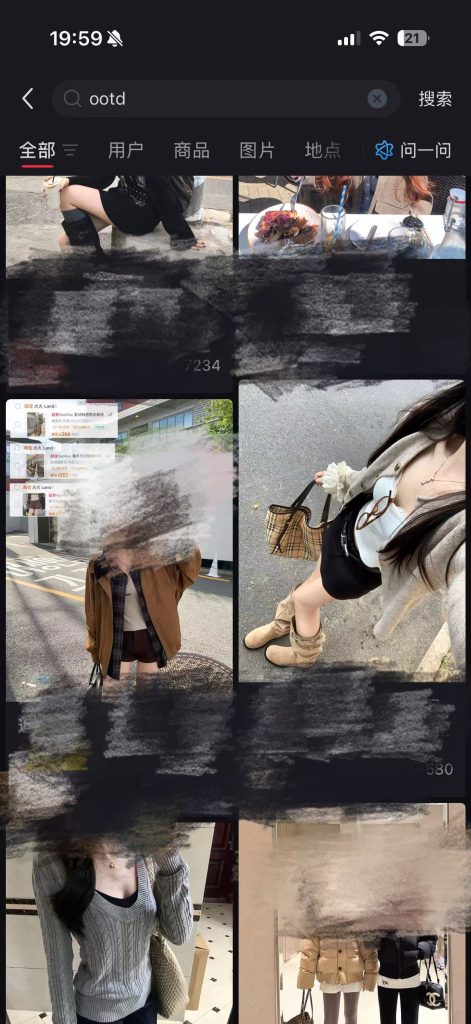
When I scroll through social media, a typical example is the “outfit check”, “thirst trap”, or dance challenge video that keeps appearing on my feed. These clips often use a relatively low camera angle and move slowly from the legs up to the chest, while the comments focus almost entirely on the woman’s body. Even when the creator is a woman, the camera language still frames “her body” as an object to be looked at, and, as Mulvey suggests(Mulvey, 1975), this visual pleasure is organised around a presumed heterosexual male viewer. The platform’s algorithm then rewards this way of looking with more visibility, likes and recommendations. Following hooks(hooks, 1992), we can also ask how a Black girl, an Asian girl, or a plus-size viewer might experience these videos differently: are they invited to identify with this “ideal” body, or are they quietly made to feel excluded from it? Some viewers respond with what we might call an “oppositional scroll”: they criticise, parody, or remix such clips to resist the gaze that structures them. In today’s platform culture, a narrow standard of beauty is produced and circulated under algorithmic power, which means platforms hold the privilege to decide which kinds of bodies become visible and desirable.
Every time I film myself or take selfies of my OOTD, I find myself wondering: am I doing this for the algorithm, for some imagined male viewer, or for myself and my friends? Perhaps an oppositional gaze today is not only about rejecting objectifying content, but also about experimenting with new ways of filming ourselves that do not assume a single, heterosexual male viewer.
Reference list:
Durham, M.G. and Kellner, D. (eds) (2006) Media and cultural studies : keyworks /. Rev. ed. Malden, Mass. ; Blackwell,.
hooks, bell (2015) ‘The Oppositional Gaze: Black Female Spectators’, in Black Looks. 2nd edn. Routledge, pp. 115–131. Available at: https://doi.org/10.4324/9781315743226-8.
hooks, bell (2015) ‘The Oppositional Gaze: Black Female Spectators’, in Black Looks. 2nd edn. Routledge, pp. 115–131. Available at: https://doi.org/10.4324/9781315743226-8.


How you portrayed social media trends in relation to Mulvey’s male gaze and oppositional gaze made a complex idea relatable and easy to understand. Your examples, such as outfit checks and dance videos, demonstrate that you truly understand how the algorithm influences what we see and who receives visibility.
Another thing I want to highlight is how you reflect on your own experience with filming and selfies, which makes the theory more personal in my opinion. Your point about experimenting with new ways of filming to resist the gaze is really thoughtful and shows a strong understanding of the ideas in action.
I think your overall writing is very good, but there are some minor issues. I suggest that you differentiate the perspectives of different user groups, such as people of different genders, body types, races, and aesthetic standards, to examine whether they can all equally engage in the “oppositional gaze.” After all, assuming the default standard of “heterosexual male audience with white/slender aesthetics” may not be applicable to many people. I also think you could include more examples of success. In reality, which users or videos have challenged mainstream aesthetics or algorithmic preferences through different ways of looking, and gained attention or sparked discussion? This would make the “theoretical critique” more concrete and inspiring.
The male gaze is a lingering problem from history. Even in a society that promotes gender equality, women still face occupational biases and other inequalities. Media often reinforce this issue by portraying women through a male-centered perspective. Some women advocate for the freedom to dress as they like, but when a woman wears revealing clothes, many men interpret it as “sexy” rather than an expression of personal freedom. In this way, women’s choices are often reshaped and judged through the lens of the male gaze.