
From Charlie’s Angels to OnlyFans, true story.
I can not be the only one who watches movies, plays video games, or watches music videos and wonders why women are often portrayed in such a sexual manner. It’s everywhere: costumes, camera angles, even character roles. And it raises an important question: why is this still the norm, and how has something so widespread become so ingrained that it often goes unnoticed until we pause and consider how deeply it shapes the way we perceive women?
Well, let’s talk about it!

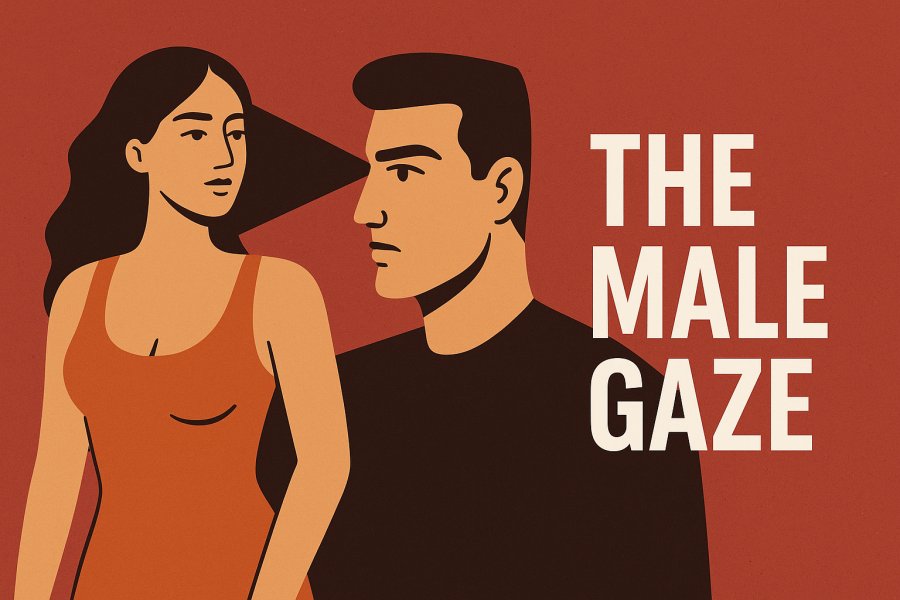
British feminist film theorist Laura Mulvey created the “Male Gaze” theory in her 1975 essay “Visual Pleasure and Narrative Cinema.“ The theory describes that the visual arts often portray women from a heterosexual male perspective, representing them as sexual objects for the pleasure of the male viewer. In other words, the camera, narrative, and audience are encouraged to adopt a lens through which women are presented for male pleasure, admiration, or control. Mulvey argued that mainstream film is structured around patriarchal ideology, positioning men as active subjects who drive the narrative, and women as passive objects to be looked at.
Women are frequently framed in ways that highlight their bodies or sexuality. Consider slow pans, close-ups of specific body parts, or costumes designed to emphasise attractiveness over functionality. Instead of being presented as full, complex characters, women are often reduced to parts, such as legs, lips, curves, or torsos, through specific camera choices. These shots aren’t accidental; they’re crafted to highlight sexuality rather than personality, skill, or agency.
Take Charlie’s Angels, for example, specifically the early-2000s adaptations. The camera often prioritises their bodies over their abilities. Scenes frequently linger on legs, midriffs, or slow-motion hair flips long before emphasising the women’s actual actions or problem-solving. In several scenes, the Angels’ introductions or fight scenes are framed with stylised close-ups of their hips, lips, and torsos, accompanied by playful or flirtatious cues. The humour and tone make the sexualization feel ‘fun,’ but the cinematic choices still highlight physical appeal as the first thing the audience should notice. Their competence is genuine, but it’s presented in a way that emphasises their desirability.
This isn’t unique to Charlie’s Angels. It’s a pattern that appears in many action films featuring female leads such as Jumaji. The emphasis on sensuality becomes part of the storytelling language, subtly reinforcing the idea that even powerful women should be visually consumable before they are fully dimensional characters.
In today’s media, social media can determine ‘social norms.’ When women are consistently framed through a sexualized lens, those portrayals shape how society understands gender, value, and identity. This can be seen in the OnlyFans culture we have today. Repeated exposure to sexualized images normalises the idea that women’s primary value lies in their appearance. Even when female characters are smart, capable, or central to the plot, the camera often reminds us that their physical appearance is part of their appeal.
For many women, especially young girls, these portrayals can quietly shape self-esteem. The expectation of being effortlessly attractive, perfectly styled, and physically flawless becomes internalised. This can lead to comparing oneself to unrealistic or stylised portrayals of oneself. Social media amplifies this: when the “ideal” is the norm onscreen, people feel pressured to replicate it in real life.
However, in response to Mulvey’s theory, contemporary discussions and creative works have explored ways to challenge the male gaze. These include developing the concept of the “female gaze” (presenting women’s experiences and perspectives from a female point of view). Filmmakers and artists are increasingly creating content that features diverse representations of women and subverts traditional objectification, promoting more equitable and authentic storytelling.
To conclude, recognising the male gaze isn’t about criticising every film or condemning every trope. It’s about understanding the lens we’ve inherited and choosing to look through it consciously. The more we challenge the norms that have shaped our screens for decades, the closer we get to stories that honour the depth, agency, and humanity of everyone who appears in them.
References:
- Loreck, J., 2016. What does the ‘male gaze’ mean, and what about a female gaze? The Conversation, 22 January. Available at: https://theconversation.com/explainer-what-does-the-male-gaze-mean-and-what-about-a-female-gaze-52486 [Accessed 30 Nov. 2025].
- Jackson, L.M., 2023. The Invention of “the Male Gaze”. The New Yorker, 14 July. Available at: https://www.newyorker.com/books/second-read/the-invention-of-the-male-gaze [Accessed 30 Nov. 2025]. The New Yorker


This was a very good read. I liked the examples you used to apply the theory which are very applicable to the main concepts of the theory. I think ensuring that we have more equal representation within the industry is important and we are heading in the right direction currently. Laura Mulvey’s theory is one to consider in terms of how the media industry can ensure that the media products that are produced are less one sided in terms of how female characters are portrayed in the eyes of heterosexual men who see women as a desire or an object, your blog clearly demonstrates this.
This article is very solidly written, and it clearly shows how the classic idea of the “male gaze” works in today’s media environment. The author uses the question of “why women are always shown like that” as the starting point and brings in examples that we see in everyday media — from movies to social media and even the culture around OnlyFans. These examples connect very naturally and help explain that the male gaze isn’t only in traditional films but is also strengthened and repeated in the digital age through how people present themselves online. The writing flows smoothly, and the way the author explains Mulvey’s theory is especially good. It’s easy to understand, not too academic, but still keeps the main ideas clear, which helps readers grasp key points like how the camera “looks” for the audience and how stories turn women into objects to be looked at.