
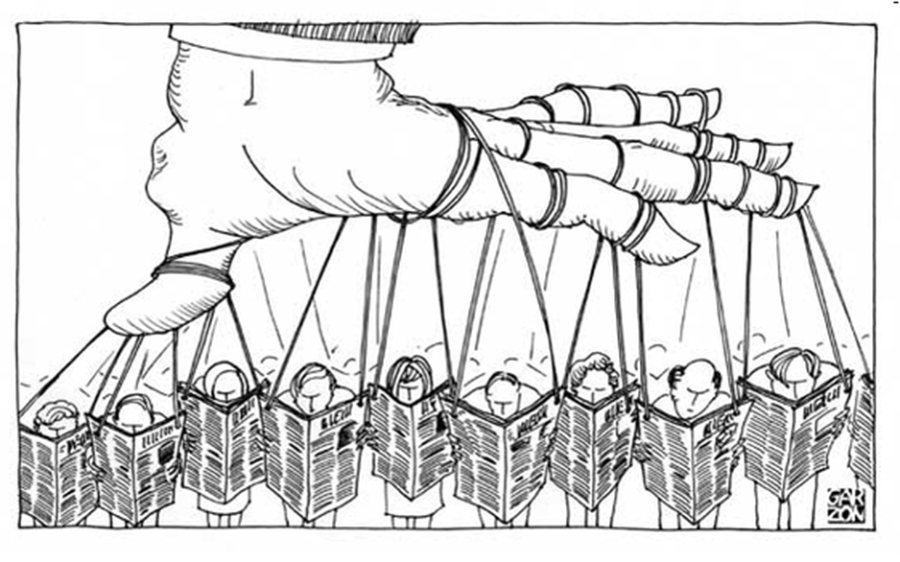
People assume we live in a world where information is spread liberally and freely, especially since the digital media world has grown so rapidly over the last few years. But is this true?
Noam Chomsky and Edward Herman’s Manufacturing Consent (1988) theory proposes that the mass media in democratic societies often function as propaganda systems for powerful interests. They argue that media systems shape public opinion, leaving the masses passive instead of active. They came up with the Propaganda Model, which argues that news and media content is filtered through structural constraints – ownership, advertising, sourcing, flak, and ideology – resulting in little to no room for interpretation or debate. It shapes how we think about political events, what we pay attention to, and what we ignore; people think this happens out loud but it actually happens very quietly, often without us even noticing. Before the news reaches us, it travels through several invisible filters, which makes you question who decides what gets released and why?
The propaganda model is built on different filters, and these filters shape what becomes news and how it is framed. One major step in this is ownership. Almost every big media corporation (or corporation in general) has an ‘owner’ that has their own financial and political interests. This heavily affects what stories are told and how they do so. For example, the BBC is frequently accused of bias from both left and right political sides, however, despite their standpoint they are known to censor certain stories and downplay big news articles. And they are not alone in this, almost every big news outlet will do this, and you will hear many people tell you to never get your news from just one outlet.
This is where social media comes into play. In the online world, people are free to post whatever they like; opinions are free to share and discussions are open to all. Active journalism is huge, and is a massive help to people when large news corporations are censoring certain coverage. However, platforms such as TikTok have been known to censor certain posts/topics in specific regions, such as controversy over Donald Trump and the Epstein Files. There is a viral TikTok by American user @dumbbirchtree who created a video speaking on the topic, went viral, and everyone started noticing her video was glitching halfway through. So as far as we think we’ve come, how free is our speech?
We are not just listening to the news anymore, we are actively working against algorithms. These algorithms promote content that gets the most engagement, but not necessarily the content that’s the most accurate or truthful. We share, laugh, and move on from online videos/trends daily, but what were not noticing is a whole algorithm being built around us, including our likes, interests, and what we engage with.
Manufacturing consent is not about labelling all media as ‘fake’ and ‘evil’, but rather about being mindful of the systems set up behind the scenes of what we see. It teaches us to be more aware, and more active as media users rather than just accepting everything at face value. So, whether we call it manufacturing consent, algorithmic curation or just our ‘feed’, we are all unknowingly participating in a shared, behind-the-scenes reality 24/7.
References:
https://chomsky.info/consent01/. Accessed: Friday 5, 2025.
Dunne, L. (n.d.) ‘Manufacturing Consent: Noam Chomsky on politics & media’, The Collector. Available at: https://www.thecollector.com/manufacturing-consent-noam-chomsky/. Accessed: Monday 8, 2025.
https://mediabiasfactcheck.com/bbc/. Accessed: Friday 5, 2025.
Chomsky, N & Herman, E.S. (1988) Manufacturing Consent: The Political Economy of the Mass Media. New York: Patheon. Accessed: Monday 8, 2025.
https://vm.tiktok.com/ZNRLS2MMM/ @dumbbirchtree, TikTok. Retrieved: Monday 8, 2025.


Hi!
Your explanation of Chomsky and Herman’s Manufacturing Consent and how it relates to the current social media environment is excellent. I appreciated how you emphasised the function of algorithms and restrictions on sites like TikTok; it demonstrates the propaganda model’s ongoing applicability in the digital era. To demonstrate the possibility of user agency in addition to media influence, you may include a quick example of how viewers actively oppose or challenge these filters, such as fact-checking communities or independent journalism. Overall your analysis is engaging, clear, and makes complex media theory very accessible. Great work!
I think your article has a clear structure, from media ownership to social platforms. You summarized the “manufacturing consent” and propaganda model clearly and applies the abstract theory to specific situations with examples from BBC, TikTok and algorithms. The language is vivid and easy to understand. You use questions and hot topics to get closer to the readers, and also emphasize maintaining a critical mindset at the end.