
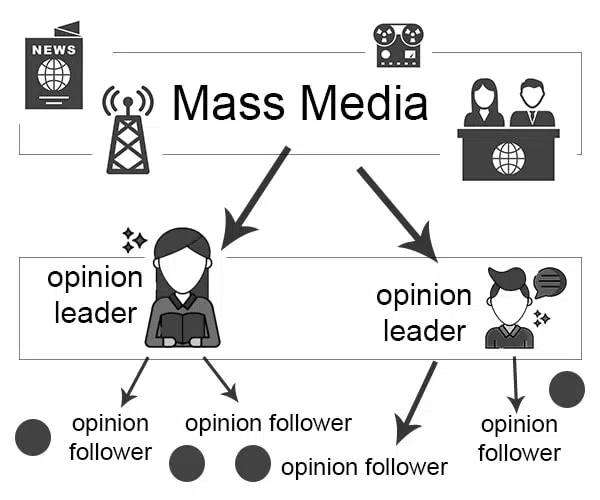
The two-step flow theory of communication tells us how information from mass media first reaches opinion leaders, influencers and celebrities of the like. At this stage, these individuals add their own interpretations and biases before sharing the media message with their followers (Katz, E, 1955). The pool of opinion followers is very large; it includes students, parents and teenagers and anyone who doesn’t do their own research, and is influenced by these opinion leaders. This group of people are dependent on the interpretation from opinion leaders, as they are perceived as wiser, smarter, relatable and credible.
Mass media are radio stations, social media platforms and large platforms that control what information is shared and what is withheld. Although they have control over information, they lack influence simply because the opinion leaders are more relatable to the common consumer as they humanise and personalise the media message, creating more accessibility to the message along with giving another perspective on how to analyse the information.
This theory explains that a lot of people do not go directly to the source of content, rather they prefer to hear it remixed by someone “they trust”. This is a juxtaposition, simply because the people who are opinion leaders often present themselves online in a way that will garner the most clicks or put them in the best light. Manipulating how they present themselves makes regular consumers feel that they are trustworthy. And propelling themselves from being an opinion follower to an opinion leader.
By positioning themselves as intermediaries, these opinion leaders can amplify, modify and damage the original message from mass media. This alters how the message can be received; you’ll see that it shapes the public understanding of the linear event. Along with this, Adorno (1944) explains that, while the world tries to sell the idea that the world is getting better, it is actually robbing us of the joy of discovering whether we truly believe the world is improving. We as individuals aren’t becoming smarter and dependable people rather overly reliant on another person and letting them shape how we grasp the media message. Opinion leaders make it easier for people to lose their unique viewpoint; they foster a sheep mentality among their followers (Ungvarsky, 2020).
Once those in the pool of opinion followers decide to truly understand this two-step process, the result will be them advancing their critical analysis, enabling them to look beyond the surface level and rightly question the authenticity and motivations behind opinion leaders’ viewpoints. The step process is evidence that consumers are often passive and likely to follow the loudest voice in the room, as the opinion leaders are the ones who actively decode the messages the mass media convey.
In summary, the two-step flow theory is a framework that explains how media messages are shared between people and the roles each plays, ranging from opinion followers who are passive and overly dependent on the active decoder and critical thinker, to the opinion leader who remixes the information they receive from mass media. Although the information is more accessible, it is given from different perspectives. Consumers must be self-sufficient and form their own opinions about the media messages they receive.
Bibliography
Media Studies (2020). Two Step Flow Theory of Communication | Definition and Analysis. [online] Media Studies. Available at: https://media-studies.com/two-step-flow/.
Hepp, A. (2019). (PDF) Katz/Lazarsfeld (1955): Personal Influence. [online] ResearchGate. Available at: https://www.researchgate.net/publication/328078453_KatzLazarsfeld_1955_Personal_Influence.
Adorno, T. and Horkheimer, M. (1944). The Culture Industry: Enlightenment as Mass Deception. [online] Available at: https://www.marxists.org/reference/archive/adorno/1944/culture-industry.htm.
Ungvarsky, J. (2020). Herd mentality (mob mentality) | EBSCO. [online] EBSCO Information Services, Inc. | www.ebsco.com. Available at: https://www.ebsco.com/research-starters/social-sciences-and-humanities/herd-mentality-mob-mentality.


You give a clear and thoughtful explanation of the two-step flow theory, and you make a strong connection between Katz and Lazarsfeld’s model and today’s influencer culture. Your points about relatability, trust, and how opinion leaders present themselves are especially strong, showing that the theory still matters in digital spaces. Overall, you engage well with both the classic theory and its modern impact, and there is good potential to add even more critical depth.