

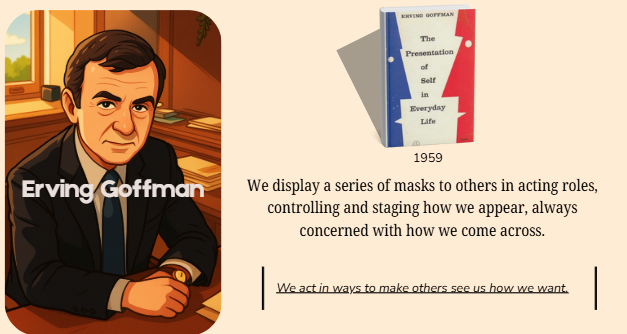
Sociologist Erving Goffman, in his 1959 book, The Presentation of Self in Everyday Life, describes “social life as a theatrical performance” People act like actors on stage, managing impressions to shape how others perceive them. His driving point was that people wear masks (social personas) tailored to different contexts, emphasising that there is no singular authentic self but rather multiple roles played depending on the situation (Haziq, 2019).
In the digital realm, this performative behaviour is amplified. Social media platforms serve as modern stages where users craft and showcase multiple selves, seeking validation and social approval through likes, comments and shares. The masks we choose to wear involve maintaining a positive social image, through filters, edits and carefully curated content designed to present an idealised version of yourself. This extreme control over one’s appearance reflects Goffman’s concept of impression management; individuals continually strive to present themselves in the best possible light (Haziq, 2019). The same feeling of pressure and conformity arises, giving individuals the idea. play along, rather than going against the status quo.
Goffman’s theory raises important questions about authenticity. While social media offers a chance for people to be more self-expressive, the opposite has happened. Platforms such as Instagram, TikTok and Facebook no longer serve as a place of inclusivity, but rather push out what is already trending and what is most liked. Instead of genuine self-expression, people often choose to follow others’ thoughts and ideas, resulting in a loss of individual identity. Many users end up mirroring the ideas of others, particularly celebrities and influencers, due to their large followings and the lifestyle they portray. Everyone is on the pursuit of validation, and this has created a performance culture where people share the best parts of their lives and never their struggles.

(Sarah H, 2022)
More negative than positive has come from digital platforms. Along with the risk of superficiality, there is a constant trait of comparing yourself to someone’s online persona. These drawbacks contribute to a more fabricated personal image online. Goffman encapsulates this vividly: “The entire world is a stage and all the men and women merely players.” Highlighting that no one is different and the same feelings and attitudes are shared by many people. Tension is built within an individual between self-presentation and self-perception; the lines are getting blurrier, and the habit of constantly being online is becoming more damaging.
Taking a look at it not just from a digital identity perspective, instead of a psychological well-being viewpoint, the pressure to perform constantly and meet online standards can lead to anxiety, burnout and worse, depression (Azem, 2019). With more users admitting this, it’s simply because social media exacerbates the feeling of not belonging.
Ultimately, Goffman’s phrase, the entire world is a stage, tells the truth of the matter: our social life is all performative. Whether offline or online, people navigate social scenarios, roles and expectations. This theory provides those who conform with a better understanding of this dynamic and how authenticity operates in both traditional and digital spaces. Goffman’s words have remained relevant even in this new era and have become a cornerstone of the truth, which numerous people refuse to acknowledge
Bibliography
Azem, L., Alwani, R.A., Lucas, A., Alsaadi, B., Njihia, G., Bibi, B., Alzubaidi, M. and Househ, M. (2023). Social Media Use and Depression in Adolescents: A Scoping Review. Social Media Use and Depression in Adolescents: A Scoping Review, [online] 13(6), pp.475–475. doi:https://doi.org/10.3390/bs13060475.
Haziq, S. (2019). Putting the best digital self forward in the age of Social Media. [online] Medium. Available at: https://medium.com/@haziqsabreen25/putting-the-best-digital-self-forward-in-the-age-of-social-media-d3dbec422b73.
Sarah Hunsinger (2022) Is social media bad for your health? Available at: https://red.msudenver.edu/2022/is-social-media-bad-for-your-health/


Hi!
Goffman’s concept of social life as a performance is explained in detail in your post, which also makes a strong connection to how people create their identities on social media. Your statement regarding validation and the pressure to project a flawless image really caught my attention; it demonstrates how impression management has become more important on the internet.
The concept of resistance is one that you might further develop a bit. It would be easier to demonstrate that not everyone sticks to the idealistic online identity by providing a brief example of people who oppose performance culture, such as by publishing unfiltered content.
Overall, your blog is intriguing, relatable, and gives the impression that Goffman’s theory is still highly relevant today.