

Adorno and Horkheimer (2002) invented the term “culture industry” to explain how media and popular culture became industrial products. Culture is no longer created for leisure and enjoyment, but for large companies to earn great profit. Products are standardised as commodities and sold back to consumers. In music, this means listeners no longer develop their own taste; the industry that produces and distributes songs shapes it. Spotify’s playlists are useful examples. Playlists like “Discover Weekly” and “Daily Mix” seem like personalised discovery, but they standardise how music is distributed.
Playlists look the same in users’ accounts. Kullick and Petry (2026) argued that Spotify’s playlist model intensifies the standardisation of music, leading to a significant drop in the diversity of sound and style in music. By comparing the hip-hop playlist from 2002 with Spotify’s RapCaviar in 2022, they found that a homogenisation trend exists in the form, rhythm, lyrics, and sampling. This indicated that the culture industry appears and operates through algorithmic distribution rather than the mass production proposed by Adorno.
Standardisation also applies to the level of visibility. According to Pachali and Datta (2025), Spotify decides which playlists to feature on users’ search pages. Users are more likely to listen to playlists that appear on their search page. Statistics show that being featured on the search page raises daily followers by 0.95%, twice the effect of adding a song by a popular major-label artist (0.45%). Thus, the platform does not just create playlists. It guides users’ attention towards certain ones. It does not force listeners to choose certain playlists, but it arranges the conditions under which choice happens. The platform controls the choice.
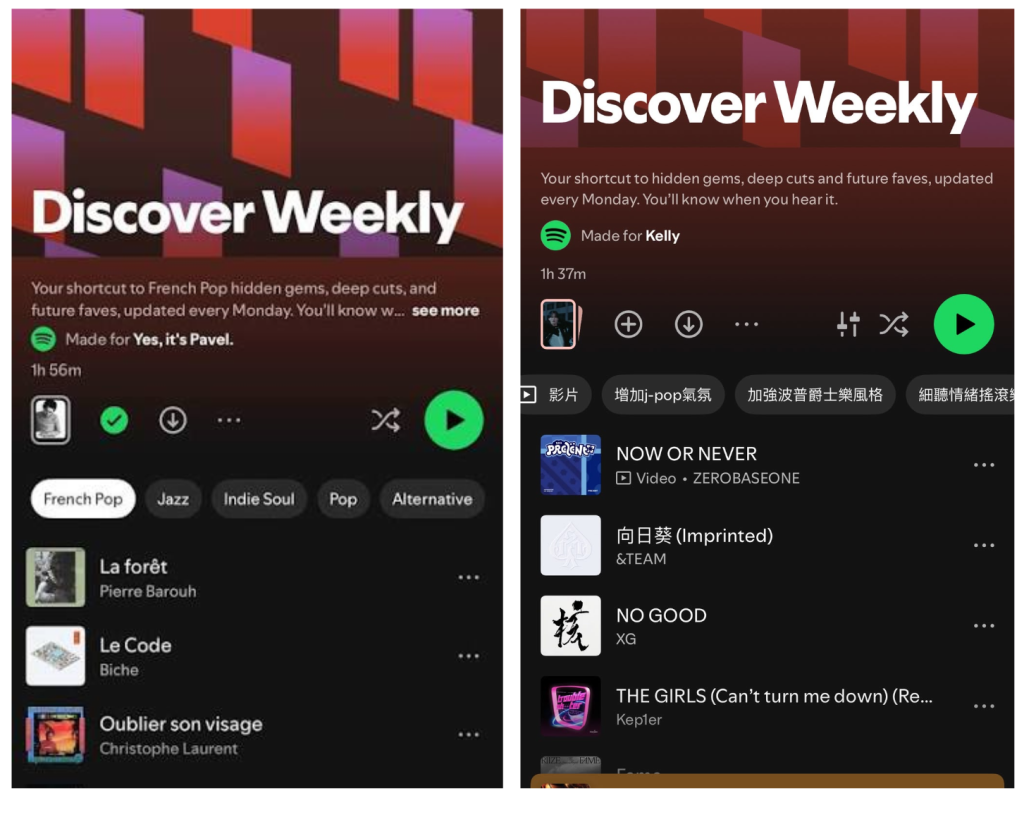
Spotify’s algorithms build a “taste profile” storing songs that you listened to, saved, or skipped so they can recommend tracks based on the data. Adorno and Horkheimer’s (2002) concept of pseudo-individualisation helps explain why the recommendation looks personalised, but it is generated from the profile the platform has built, not from your independent taste. Spotify claims that the music is yours, proving Discover Weekly has “personality”, but that personality is a commodity sold to us as if it were natural.
However, the theory has limitations. Adorno and Horkheimer (2002) view consumers as passive victims of the culture industry, and assume it as a mass deception by making false promises of freedom and happiness. They underestimate how actively audiences engage with media. Personally, I know the “Discover Weekly” is designed by an algorithm to maximise retention; I still actively choose to open it. Experiencing real excitement when exploring new tracks remains something the theory cannot explain.
Despite the limitations, the culture industry remains invaluable. It urges us to look beyond the “personalised” interface to ask critical questions: Who designs the taste profile and who profits from the standardisation? This theory transforms me from a passive listener into a conscious consumer, enjoying algorithmic playlists while recognising how platform capitalism continuously shapes and commodifies our music consumption.
Reference
Adorno, T. and Horkheimer, M. (2002) Dialectic of Enlightenment: Philosophical Fragments. Stanford: Stanford University Press.
Kullick, P. N. and Petry, J. (2026) ‘From Adorno to 50 Cent: Financialized platform capitalism, Spotify, and the culture industry in the twenty-first century’, Finance and Society, 12(1), pp. 1–25. doi: 10.1017/fas.2025.10015.
Pachali, M. J. and Datta, H. (2025) ‘What Drives Demand for Playlists on Spotify?’, Marketing Science, 44(1), pp. 54–64. doi: 10.1287/mksc.2022.0273.


