
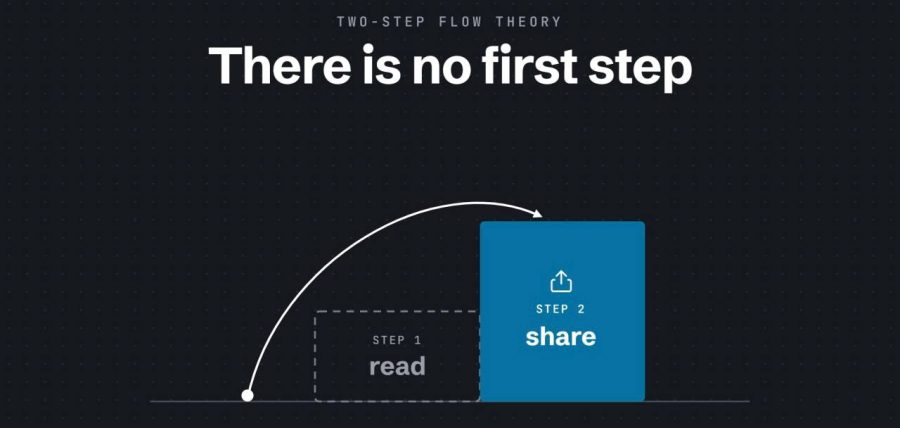
In June 2016, the satirical Science Post published a ‘Study: 70% of Social Media users only read the headline of science stories before commenting’. Nearly 46,000 people shared it anyway.
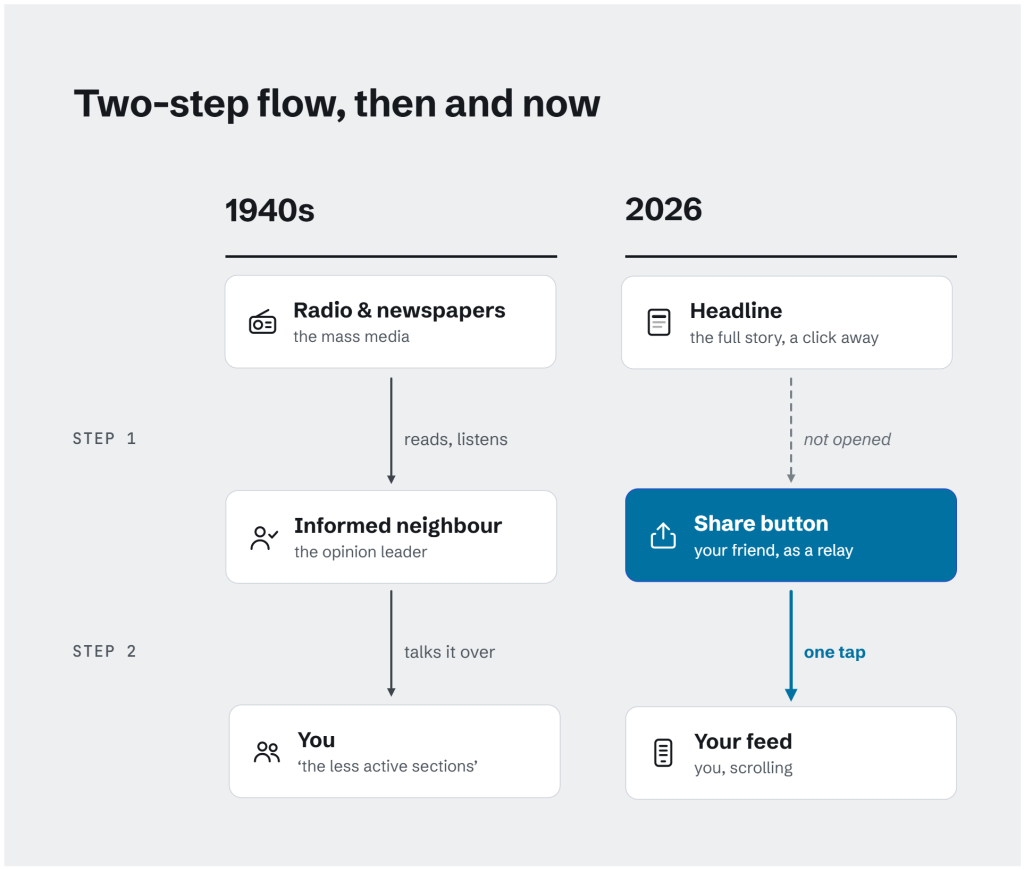
The theory this joke breaks began in 1940, when Lazarsfeld’s team found Ohio voters swayed more by other people than by radio or newspapers. Katz and Lazarsfeld developed this into the two-step flow: ideas pass from the media to ‘opinion leaders’ and from them to ‘the less active sections of the population’. Оpinion leaders consumed more media than those they advised, so the relay was an informed filter and media effects were ‘limited’. Today, the person in between may not have read anything at all.
A 2016 study found that 59% of news links shared on Twitter were never clicked. If you read that as ‘59% of people share without reading’, you did what this post describes, and so did much of the press. The study counted links, not people, and many were probably never re-shared.
Even so, in 2020 Twitter (now X) began asking users to open articles before retweeting: ‘Headlines don’t tell the full story’. WhatsApp marks messages forwarded many times with a double arrow: your friend is not the source, only a relay.
So why does it take a pop-up to make us read?
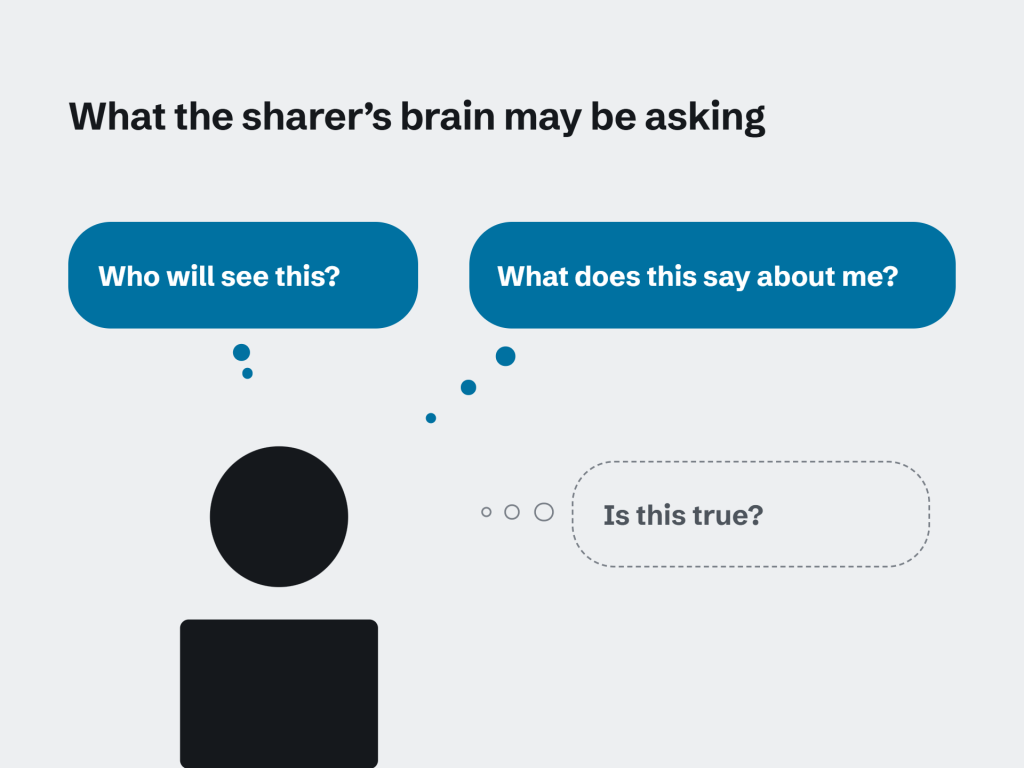
When Falk and colleagues scanned people first hearing ideas, those that later spread engaged mentalising (imagining others’ minds) and reward systems more strongly, as if the second step began during the first. Scholz and colleagues found that a ‘value of sharing’ signal, built from thoughts about self and others, predicted the real-world sharing of 80 New York Times articles beyond participants’ own ratings. The brain seems to ask ‘What does this say about me, and who will see it?’ as much as ‘Is this true?’ This is a neural echo of Katz and Lazarsfeld’s primary groups. These are small lab studies though, and a scan shows mechanism, not meaning.
Lazarsfeld was more right than he realised. Trust is more about people than sources. Readers judged the same article as more accurate when shared by a trusted public figure from a questionable source (49%) than by a distrusted person sharing from the Associated Press (32%). This process enhances credibility by setting the agenda rather than just filtering information. Unrecognised shares play a key role in determining what circulates. Although friction can be effective, it is often rare because it reduces engagement, which is valuable for platforms
From my own practice: I almost never repost. There is one younger friend of mine who’s interested in media and brings me what she comes across, and I explain it, rarely with the right argument the first time: even offline, passing it on outruns thinking it through. Though the first step of the theory reliably survives with another friend, a genetics student, because we do the research together, which is a primary group reading rather than relaying.
The urge to share is ancient, but in the 1940s the second step was a conversation. Now it is a button. Two-step flow still maps who carries ideas, but it can no longer assume they have read them. As AI chatbots summarise the news, the first step may vanish altogether. When did you last share something you had not opened?


