
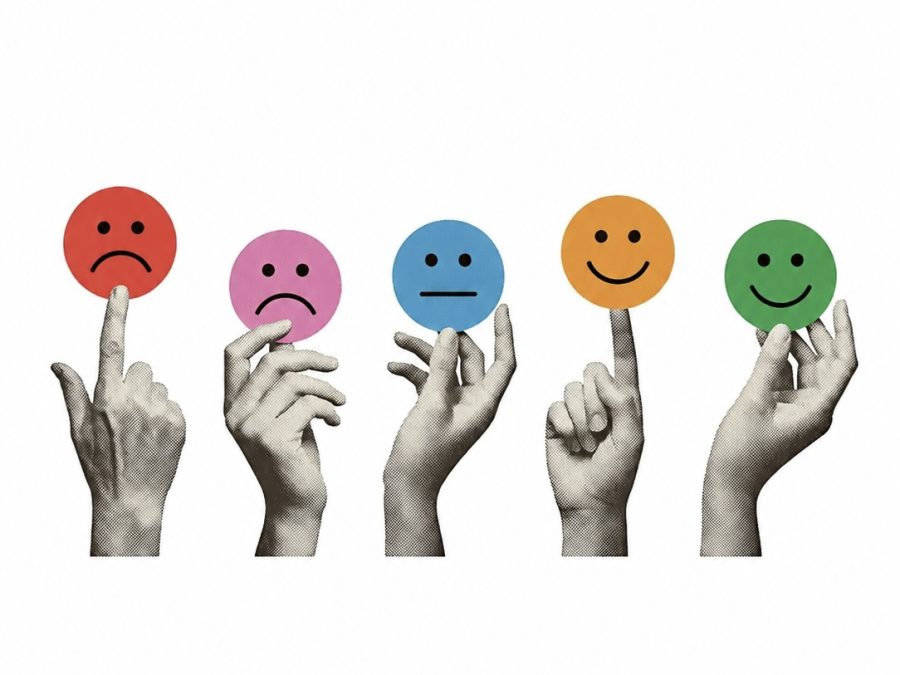
On WeChat, a popular messaging app in China, the seemingly friendly “smiling emoji” is sometimes used to express frustration, dissatisfaction or even sarcasm. But does the sender’s intended meaning always match the receiver’s interpretation?
Hall (2006) criticised the traditional linear communication model, arguing that communication comprises several interconnected yet relatively autonomous moments. Producers construct meaningful messages through symbols and cultural codes, while audiences need to decode these messages to understand their meaning. Hall further pointed out that the meaning structures of encoding and decoding may differ because of differences in their frameworks of knowledge and social conditions. Therefore, there is no necessary correspondence between encoding and decoding, meaning that the producer’s intended meaning may differ from the audience’s interpretation (Hall, 2006).
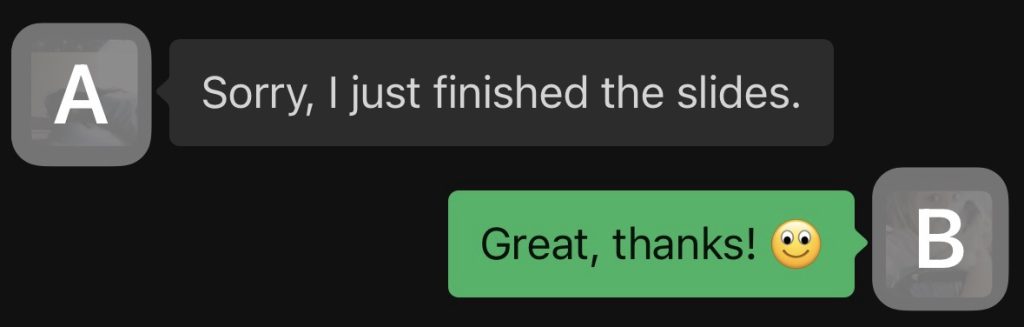
This relationship can also be observed through the use of the smiling emoji on WeChat. Cui et al. (2024) found that Chinese teenagers often use this emoji to express sarcasm. Suppose that in a group assignment, A promised to complete the slides on Monday but did not send them to B until Tuesday. B replied, “Great, thanks!” and added the WeChat smiling emoji. Although the text appears to express gratitude, B intends to convey dissatisfaction with the delay. However, A may interpret the message as a sincere thank-you or realise that B is being sarcastic. This shows that even if the sender uses specific cultural codes to encode sarcasm, they cannot guarantee that the receiver will interpret the message as intended. The two people may have different habits of using emoji and different cultural experiences, so their encoding and decoding codes may not be fully symmetrical. However, if both are familiar with the sarcastic use of this emoji, the intended meaning may be successfully communicated. This reflects Hall’s argument that although encoding and decoding are relatively autonomous, a correspondence between them can still be established. This correspondence is not natural but depends on their shared understanding of relevant cultural codes.


Although encoding cannot guarantee how a message will be decoded, it still sets limits on possible interpretations (Hall, 2006). This means that although receivers have some freedom to interpret messages, their understanding is still influenced by the message itself, cultural codes and the context of communication. Therefore, different interpretations are not completely random. Although Hall developed his theory in the context of television communication, the WeChat example shows that the relationship between encoding and decoding can also help us understand differences in meaning in everyday digital communication.
Ultimately, a smile does not always mean friendliness. This reflects Hall’s argument that meaning is not simply transmitted from the sender to the receiver, but is produced and interpreted through distinct yet interconnected processes of encoding and decoding.
Reference:
Hall, S. (2006) ‘Encoding/Decoding’, in Durham, M.G. and Kellner, D.M. (eds.) Media and cultural studies: keyworks. Rev. ed. Oxford: Wiley-Blackwell, pp. 163-173
Cui, J., Dandan, Y.R., Yang, B. and Jing, Y. (2024) ‘Which emoji are markers of sarcasm among Chinese teenagers using the WeChat app?’, Heliyon, 10(23), e39796.
Available at: https://doi.org/10.1016/j.heliyon.2024.e39796


