
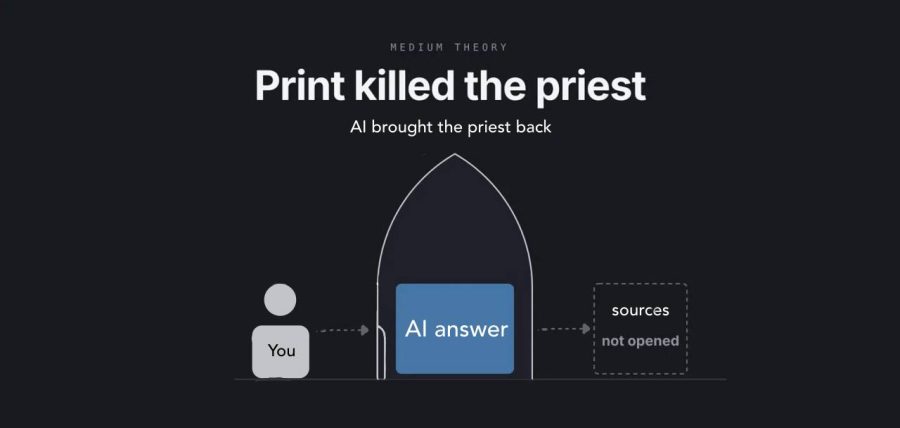
In 2007, Google estimated that fewer than 1% of searches utilised the ‘I’m Feeling Lucky’ feature, which directs users to a single page. Currently, when Google displays an AI-generated summary as the default answer, users click on a search result in only 8% of visits, compared to 15% previously. Additionally, they click on a source within that summary just 1% of the time.

Does format matter if the facts remain the same? According to McLuhan, “the medium is the message.” For example, ten links send you to read, while a single paragraph reads for you. Innis noted that the medieval Church had a “monopoly over religious information” through hand-copied scriptures until the advent of print allowed believers to read without relying on “second-hand sources such as clergymen”. In this way, search engines have become our modern printing press, and AI-generated answers are bringing back the role of the priest.
Innis also argued that empires survive by combining media that endure with media that travel. AI does both, freezing the web into models in a few companies’ data centres and delivering it instantly to every phone.

The open web once exchanged content for traffic, but AI now takes content while keeping the traffic. The New York Times has sued OpenAI and Microsoft for using its articles in AI training. Additionally, Cloudflare blocks AI crawlers by default, allowing websites to charge for each crawl. Peters notes that media is foundational, with the digital landscape relying on essential resources. The International Energy Agency warns that data centre electricity consumption could more than double by 2030, and in Ireland, data centres account for 23% of metered electricity usage, surpassing all urban homes combined.
Understanding this issue revolves around the concept of power, which drives states to seek influence. For example, China requires that generative AI align with “core socialist values”. In contrast, U.S. federal agencies prioritise models that promote “truth-seeking” and “ideological neutrality,” as outlined in Executive Order 14319. Some users believe that these models tend to favour leftist viewpoints, a perception that reflects long-standing challenges. For instance, in 1559, Rome responded to the rise of the printing press by creating the Index of Prohibited Books, which even included bans on Bibles written in common languages. This ongoing discussion about bias in information models is essential as we work towards a more balanced and transparent approach to sharing knowledge.

Whether this medium changes our brains is unclear: the ‘Google effect’ on memory failed to replicate, and the viral MIT EEG study of ChatGPT users remains a preprint. Its economic and political effects are already measurable.
Williams would label my argument as technologically deterministic. Choosing one answer instead of multiple links is a business decision that keeps users on Google, not a matter of destiny. McLuhan might call this phenomenon retribalisation, but Towns argues that McLuhan’s idea of ‘tribal’ is rooted in colonial psychiatry concerning Africans, making ‘recentralisation’ a more accurate term. Park and Curran would question whose answer it truly is, considering that Llama 2 was trained on text that was nearly 90% English.
The previous article suggested that AI could eliminate the first step of the two-step flow of communication. Medium theory emphasises who benefits from this change. When was the last time you scrolled past an AI-generated response to consult an original source?


