
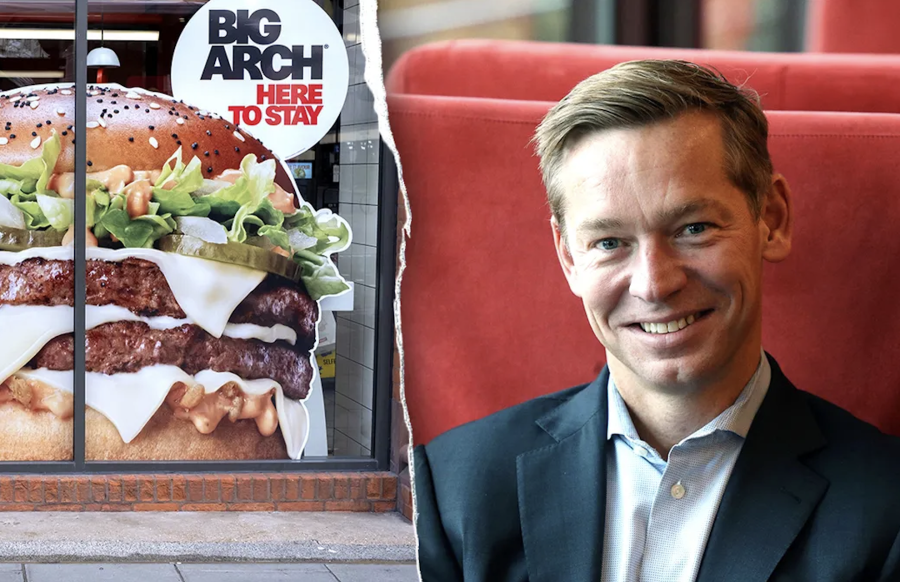
In February 2026, McDonald’s CEO Chris Kempczinski posted a video on Instagram of himself tasting their new ‘Big Arch Burger’ to promote it before the new burger’s launch. However, the video quickly went viral online and was met with widespread ridicule. Viewers mocked Kempczinski’s stilted manner of speaking, the ‘small bite’ he took during the tasting, and his habit of constantly referring to the burger as a ‘product’. Many viewers felt that Kempczinski exuded an elitist, kale-eating aura and did not genuinely enjoy his company’s burgers. Competitor brands were quick to release their own videos, joining in on the mockery (Otero, 2026).
This series of events led me to ponder a question: why did McDonald’s intended message fail to match the audience’s interpretation? The answer to this question can be found in Stuart Hall’s (1980) encoding and decoding model.
Encoding: what McDonald’s meant
Stuart Hall argues that producers encode media texts with a “preferred reading”. Here, McDonald’s encoded quality, enjoyment and authenticity. The CEO himself appears in the video, demonstrating McDonald’s confidence in its new burger and the importance it attaches to the launch of this new product. And the lines in the video such as ‘a big bite for a Big Arch’ and ‘enjoy the lunch’, as well as gestures such as revealing the burger’s fillings, are all intended to convey the deliciousness and excitement of eating the new burger.
Decoding: what audiences saw
However, most viewers decoded the video as awkward, forced and inauthentic. According to Hall’s theory, encoders and decoders do not always share the same codes because their frameworks of knowledge often differ due to their different social and cultural backgrounds. In this case, Kempczinski spoke in the language of commercial PR, like the words “test”, “products”, etc. Audiences read the video through the lens of social media food content, where authenticity means big bites and exaggerated reactions. Judged by this standard, Kempczinski’s small bites and commercial language looked like acting. Furthermore, senior executives at large corporations are inherently perceived as elitist and lacking the common touch. The public is naturally sceptical about the idea of ‘a CEO eating fast food’. Because the two sets of codes did not match, the preferred reading does not work.
Re-encoding: from decoders to encoders
Hall argued that audiences are not passive receivers of meaning. His model, first written in 1973 and designed for television, assumed that viewers’ readings of it largely took place in private, while he did not anticipate decoding becoming this public and this spreadable. On social media, audiences go further. They clip, remix and meme their readings, so decoding becomes a new act of encoding. Jenkins (2006) describes this as participatory culture. McDonald’s wanted viewers to focus on the burger, but attention shifted to how the CEO ate it. After that, competitors such as Burger King, Wendy’s and A&W took up and took advantage of this oppositional reading and re-encoded it in their own promotional content, like eating burgers with big bites, suggesting their burgers were better.
Critical Reflection
Do social media platforms always encourage one reading? This case was dominated by oppositional readings, but others existed. Platform algorithms reward the most shareable reactions, and in this case, the mockery spreads much faster than “the new burger is good”. Visibility is therefore not the same as prevalence.
Can negative decoding still generate attention? The video drew more than 1 million views. Even though audiences did not decode it as intended, the debate gave McDonald’s new burger huge exposure. The failure to communicate the intended meaning does not necessarily mean the failure of a marketing campaign. In Goffman’s (1959) terms (see the previous blog), viewers spotted the cracks in a front-stage performance.
References
Goffman, E. (1959) The presentation of self in everyday life. Anchor.
Hall, S. (1980) ‘Encoding/Decoding,’ in Stuart Hall et al. (eds) Culture, Media, Language. Hutchinson, pp. 128–138. https://spkb.blot.im/_readings/EncodingDecoding_HALL_1980.pdf.
Jenkins, H. (2006) Convergence culture: Where Old and New Media Collide. NYU Press.
Otero, I. (2026) Going Viral for the Wrong Reasons: The McDonald’s Big Arch Case Study. https://marshall-johnstonmm.com/2026/03/18/going-viral-for-the-wrong-reasons-the-mcdonalds-big-arch-case-study/.


