
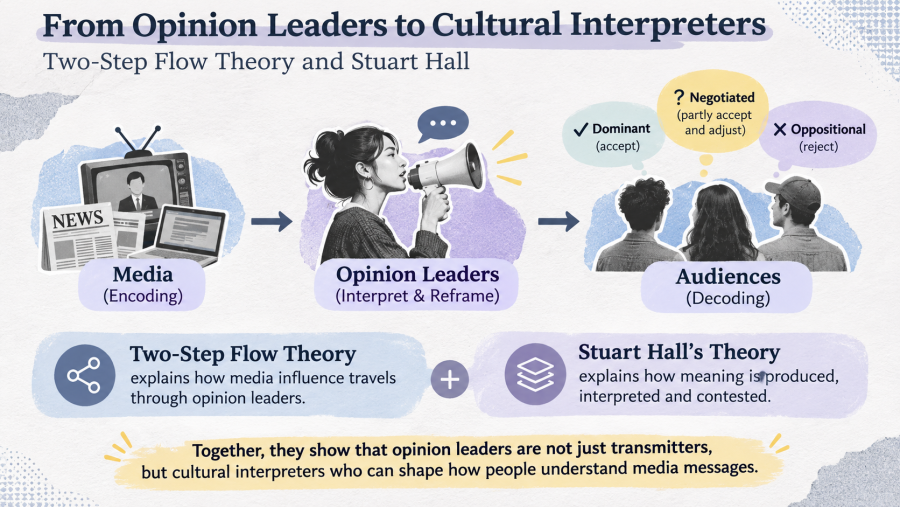
In modern society, people receive information from social media every day. However, the way people understand information is often influenced by others. This can be explained by Two-Step Flow Theory and Stuart Hall’s Encoding/Decoding Theory.
Two-Step Flow Theory, developed by Lazarsfeld and later expanded by Katz, suggests that media messages do not always influence audiences directly. Instead, information often reaches opinion leaders first, who then share their views with others. For example, people may trust a technology blogger’s opinion about artificial intelligence more than the original news report.
However, Stuart Hall’s Encoding/Decoding Theory adds another important perspective. Hall argues that audiences do not simply accept media messages. Instead, they interpret information based on their own experiences, cultural backgrounds and beliefs. He identifies three possible readings: dominant, negotiated and oppositional.
When these theories are combined, opinion leaders become more than just information transmitters. They also act as cultural interpreters who can change how people understand media messages.
For example, when news media describe AI as a positive development, some influencers may support this view, while others may focus on unemployment and social inequality. As a result, the same information can create different meanings among different audiences.
This also connects to Hall’s ideas about representation and cultural power. Media do not simply reflect reality; they help construct how society understands it. Opinion leaders can strengthen dominant ideas or challenge them by offering alternative interpretations.
In today’s digital world, algorithms make this process even more complex. Platforms such as TikTok and YouTube influence which opinions become visible, while influencers help shape how audiences understand them.
Ultimately, Two-Step Flow Theory explains how information travels, while Stuart Hall explains how meaning is created and challenged. Together, they show that modern communication is not just about sharing information, but also about shaping people’s understanding of reality.
References
- Hall, S. (1980). ‘Encoding/Decoding’. In Culture, Media, Language. Hutchinson.
- Hall, S. (1997). Representation: Cultural Representations and Signifying Practices. Sage.
- Katz, E. and Lazarsfeld, P. F. (1955). Personal Influence. Free Press.


