
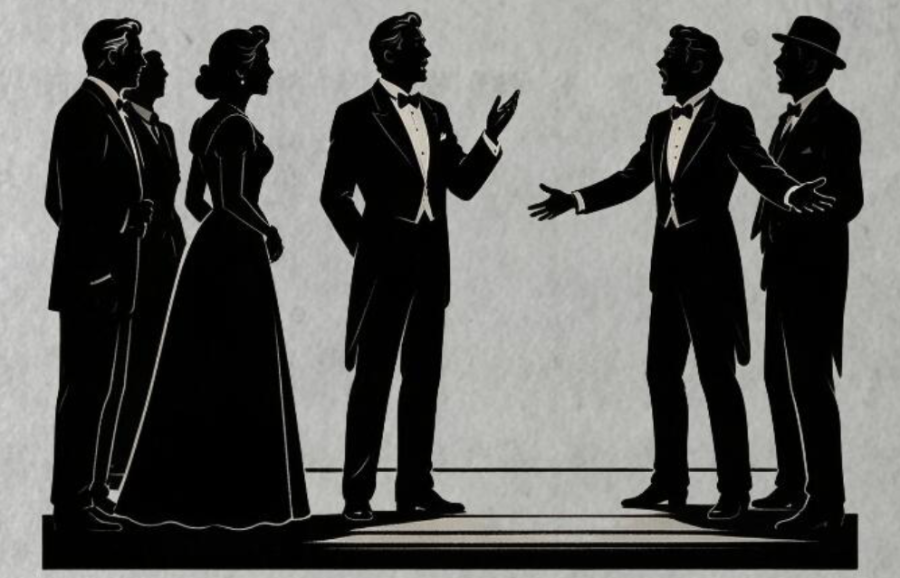
Do our digital identities truly reflect who we are, or are they a performance of the image we want others to see? This question may be too binary. According to Erving Goffman’s dramaturgical analysis, this post argues that digital identities are not merely presented by individuals, but are collectively constructed and negotiated with the audience.
In the book The Presentation of Self in Everyday Life (1959), Goffman proposed Dramaturgical Analysis, likening social life to a theatrical performance. He distinguished between a person’s identities on the front stage and the back stage. On the front stage, people perform for an audience, maintaining consistency in their setting, appearance and behaviour. Performance is often a collaborative endeavour. The Performance Team describes a group of individuals who cooperate to perform a particular identity. Backstage, they reveal a more authentic self, which may even contradict their front-stage performance to some extent. Goffman also introduced the concept of impression management, which describes how people, whilst presenting themselves, attempt to influence others’ perceptions of them. Therefore, identities are performed through interaction.
In today’s digital world, the way couples construct their digital identities on social media is a prime example. The couple-goals image is primarily constructed by selectively presenting front-stage content, such as dates, holidays, and anniversaries, which aligns with the audience’s imagination of the ideal couple. Meanwhile, arguments, household chores, and negative emotions are hidden backstage. The couple-goals content published on social media is all a form of impression management, for example, coordinated outfits, selected filters and romantic captions. This impression management relies primarily on both partners’ collaborative performance to construct a cohesive image. Finally, the audience’s likes and comments validate the relationship, thereby constructing the image. Consequently, digital identity is not only performed by the individual but also collectively constructed.

However, identities shaped by performance and management are not necessarily false. Goffman argues that performance itself is not deception, nor does it hide a true self behind it. Rather, the self is the effect produced by performance. For a couple, it is possible to be genuinely happy while choosing how to present that happiness. Therefore, the question posed at the beginning is not entirely accurate. Nevertheless, Goffman’s dramaturgical analysis has become more complex in the digital age. The audience in Goffman’s theory is physically present and limited in space, but digital content can reach friends, family, colleagues and strangers at once, which is a phenomenon known as Context Collapse (Davis and Jurgenson, 2014), referring to different audiences merging into one, blurring the distinction. The like and comment functions on social media platforms make the audience’s reactions immediately visible, enabling publishers to adjust their performances in response to the feedback. Therefore, the audience is not merely observing the performance but actively shaping and constructing it.
According to an analysis of Goffman’s dramaturgical theory in the digital age, digital identities are not merely about self-presentation or a single performance. They are also performances co-created by members of the same group and constantly reshaped by audience feedback.
References
Davis, J.L. and Jurgenson, N. (2014) ‘Context collapse: theorizing context collusions and collisions,’ Information Communication & Society, 17(4), pp. 476–485. https://doi.org/10.1080/1369118x.2014.888458.
Goffman, E. (1959). The presentation of self in everyday life. Anchor.


Hello! I found the example of couples presenting their relationships online quite interesting, as it shows how people can work together to create a certain image for others. Your point about audience reactions also stood out to me, especially how likes and comments can influence what people choose to share. Perhaps you could include another everyday example of context collapse to help explain how different audiences can affect someone’s online behaviour. Overall, I think you’ve approached the topic incredibly well and made good use of Goffman’s theory throughout. Well done!
I really like your point about how digital identities are shaped by both ourselves and our audience. I agree that people often choose to show only the positive parts of their lives on social media. I also think that likes and comments can influence how people present themselves online. Sometimes, people may even change their behaviour to meet others’ expectations. This makes me wonder if social media allows us to express our true selves or encourages us to become someone others want to see.