
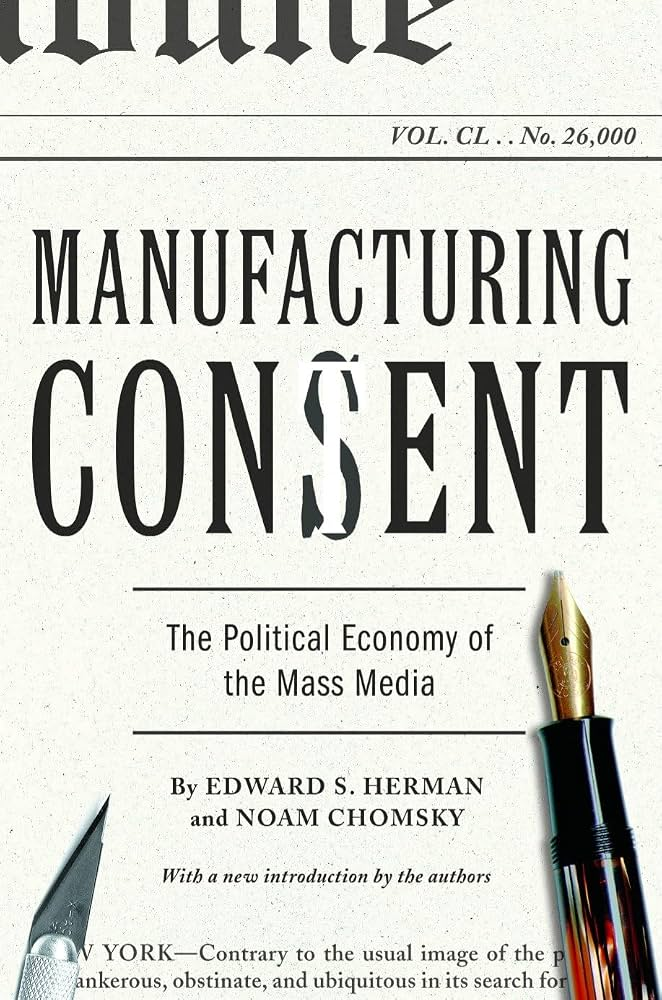
Ever wonder how much of your worldview is based on the media that you consume? Media has a great influence and role in opinion building and awareness about the surrounding situation whether it is news on TV or Tik Tok or Instagram. Not everything we are given is objective, however. This is connected with the concept of the “Manufacturing of Consent,” which explores how they are able to shape opinion through the media.
What is Manufacturing Consent?
The concept was introduced by Edward S. Herman and Noam Chomsky in Manufacturing Consent: The Political Economy of the Mass Media, (1988). They think the mass media is not only a means of information but it also helps shape the audiences view of the world.
Their Propaganda Model is based on five filters on what is produced in the media: ownership; advertising; dependence on the official sources; negative reaction to criticism (flak); dominant ideology. These filters can help to show why some stories are pursued and others aren’t.
Social Media and Public Opinion
Manufacturing Consent is still relevant today, especially because of the growth of social media. The news and information can be accessed in a quick manner through social media sites such as TikTok, Instagram and YouTube. But algorithms affect the types of stories that appear on users’ feeds, and they could be reading the same opinion repeatedly and fewer other perspectives.
For example, in certain political discussions or on important international events a couple of opinions may be heard more frequently. If the same opinions are continuously experienced, one may start to think that this is the majority opinion therefore developing their own opinion based off of what they read online. This is related to McCombs and Shaw’s (1972) agenda-setting theory that argues that the media sets the agenda on issues by selecting which ones get attention. Media cannot tell a person what to think, but it can influence the thinking of what is important.
Are Audiences Being Manipulated?
The one question you need to ask is whether or not someone just eats what others feed them. Weiner K. Herman and Noam Chomsky propose that media systems are able to restrict information.
However, social media can also be a place where people can challenge the dominant narrative, due to all of the opinions that can be found on a certain topic , to provide alternative perspectives and challenge powerful organisations.
But with misinformation it can be hard to discover sources that are reliable. Just because you have additional information doesn’t necessarily mean you have a better understanding of the issue.
Conclusion
Manufacturing Consent is a good introduction to the subject of media and public opinion. Herman and Chomsky show how the political and economic agenda can influence what information is received by audiences.
There is a possibility that other opinions on social media can be influenced by algorithms and misinformation, which can affect one’s belief. Finally, it is crucial to be critical of the information we take in, and to consider other points of view.
References
Herman, E.S. and Chomsky, N. (1988) Manufacturing Consent: The Political Economy of the Mass Media. New York: Pantheon Books.
McCombs, M.E. and Shaw, D.L. (1972) ‘The agenda-setting function of mass media’, Public Opinion Quarterly, 36(2), pp. 176–187.
Couldry, N. and Mejias, U.A. (2019) The Costs of Connection: How Data Is Colonizing Human Life and Appropriating It for Capitalism. Stanford: Stanford University Press.


