

When we browse social media, we often come across videos from bloggers sharing affordable and good products, which help ordinary users find suitable products within their limited budgets. Recently, I saw such a post on RedNote. The blogger recommended many skin care products and received a lot of likes. The comment section also featured many different attitudes. Regarding this phenomenon, Hall (1973) argues that the meanings encoded by media producers may differ from those decoded by audiences.
The blogger in the video acts as an information producer and encodes the message, conveying a preferred meaning to the audience: Effective skincare doesn’t necessarily require expensive products, affordable skincare products are also worth trying. The blogger explains personal experiences by sharing daily items such as Vaseline, enhancing credibility first, and then labels them as “good items for personal use” to recommend to the viewers. As Liu (2021) suggests, influencers use personal content to promote brands, which may make product recommendations appear more relatable. While the video appears to provide practical skincare advice, its positive product presentation may also encourage consumption.
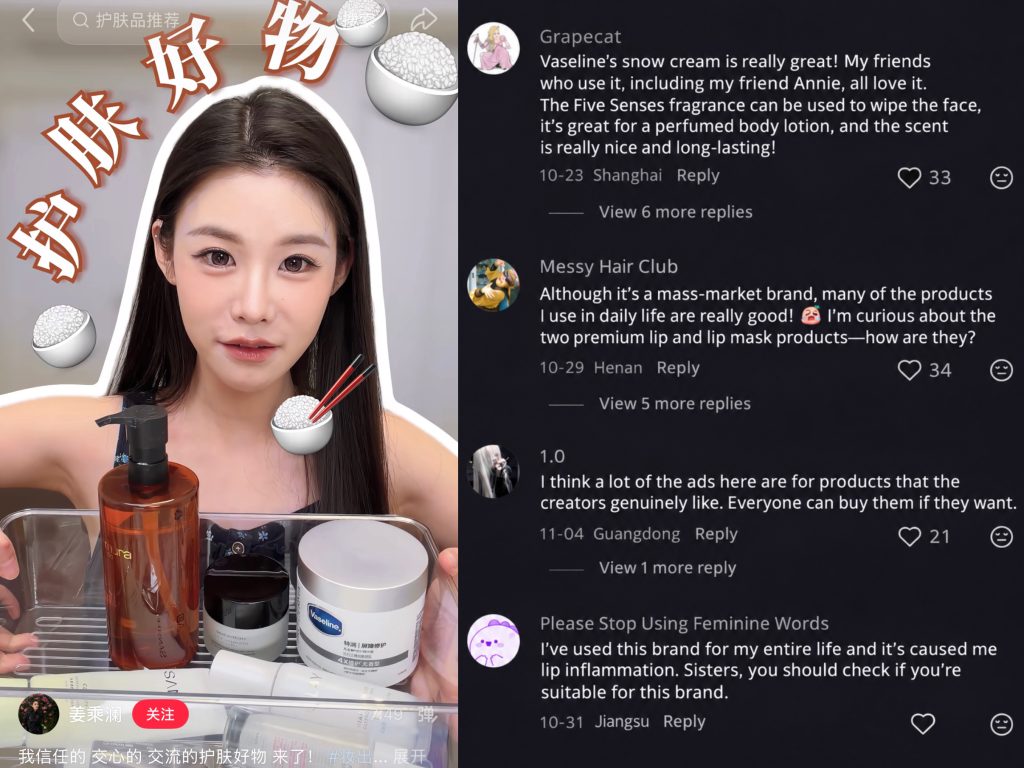
Even if the blogger builds a positive preferred meaning, the audience may not fully accept it. Hall (1973) identifies different decoding positions, which can be illustrated through the video’s comment section. Firstly, the dominant-hegemonic reading is reflected in a comment from one viewer praising the product’s fragrance and effectiveness. She basically accepted the preferred meaning conveyed by the video, which was that affordable skincare products can also be effective. Several other viewers were aware that the video had an advertising component, but they still expressed their approval of the product and raised questions about the efficacy of other products in the video. This is an example of negotiated reading, where one accepts the video’s viewpoint while retaining one’s own judgment. An oppositional reading may be reflected in a viewer’s comment about developing lip inflammation after using the product. Her negative experience challenges the blogger’s description of the product’s functionality. However, rejecting one product does not necessarily mean rejecting the video’s broader message about affordable skincare.
Hall’s theory makes us realize that the audience has the autonomy to interpret. However, in actual interpretation, the audience’s attitude can be more complex and may not be clearly classified into three positions. For instance, the audience may approve of the skincare concept but still remain skeptical about the product. Liu (2021) mentioned that trust also affects the audience’s reaction. This suggests that Hall’s three decoding positions are useful analytical categories, but they may not fully capture the complexity of individual responses.
I also noticed that when browsing a product recommendation, I would initially accept the information with a positive attitude. However, when I saw different interpretations, my thoughts would change. This indicates that the audience’s stance is not fixed.
Overall, Hall’s encoding and decoding model demonstrates that the meaning of media is not determined solely by the creators, but is formed through the continuous interpretation by the audience. However, real audience responses are often more complex than the three decoding positions suggest.
References
Hall, S. (1973) Encoding and decoding in the television discourse. Discussion Paper. Birmingham: University of Birmingham. Available at: https://epapers.bham.ac.uk/id/eprint/2962/ (Accessed: 15 November 2026).
Liu, S. (2021) ‘The impact of influencer marketing on brand engagement: A conceptual framework’, Advances in Social Science, Education and Humanities Research, 615, pp. 2219–2224. Available at: https://doi.org/10.2991/assehr.k.211220.383 (Accessed: 15 November 2026).
姜乘澜(2026)‘我信任的 交心的 交流的护肤好物 来了!’ [Video]. 小红书 (RedNote). Available at: https://xhslink.cn/o/ZMkHrks6u1 (Accessed: 15 November 2026).


